Thailand Sets Data Centre Rules
Thailand's data centre committee sets minimum requirements for operators as applications surge and investment climbs toward a regional hub role.
Key points
- Thailand's data centre committee said on Tuesday that it will establish a set of minimum requirements for data centre operators, including standards for location and land use, fuel storage and water management infrastructure, and an environmental code of practice.
- Data centres will be divided into seven tiers based on power demand.
- The criteria are to be submitted to cabinet next week, and new applications are expected to open in early 2027.
- Existing data centres will have one year to meet the new minimum requirements.
Thailand's data centre committee said on Tuesday that it will establish a set of minimum requirements for data centre operators, including standards for location and land use, fuel storage and water management infrastructure, and an environmental code of practice.
Data centres will be divided into seven tiers based on power demand.
The criteria are to be submitted to cabinet next week, and new applications are expected to open in early 2027.
Existing data centres will have one year to meet the new minimum requirements.
Danucha Pichayanan, secretary-general of the National Economic and Social Development Council, said there are more than 100 prospective operators.
The rules come as Thailand scrutinises the impact of a wave of data centre investments in recent years.
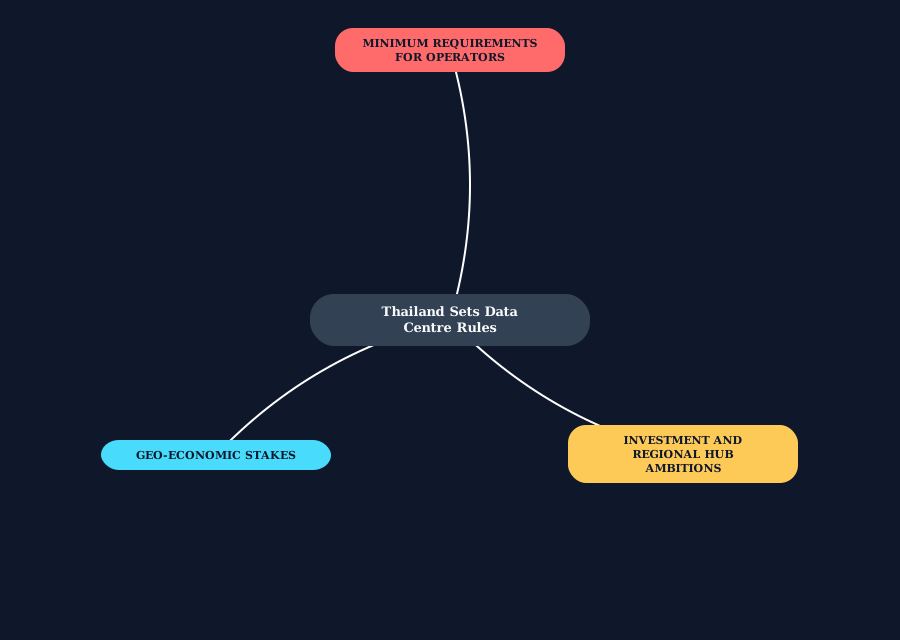
Minimum Requirements for Operators
As of February, Thailand had 42 data centres, representing 3,400 megawatts of IT load and about 750 billion baht, or 22.58 billion dollars, in investment.
Southeast Asia's second-largest economy wants to position itself as a regional data infrastructure hub, similar to Singapore and Malaysia.
Some of the largest projects come from TikTok, which invested 24.61 billion dollars this year, and Google, which announced a 1 billion dollar investment in data centre and cloud architecture in 2024.
The surge reflects how global technology firms are seeking capacity in Southeast Asia amid rising demand for cloud services and digital infrastructure.
Investment and Regional Hub Ambitions
The rules illustrate how governments are using regulation, not just incentives, to manage strategic digital infrastructure.
By setting tiers tied to power demand and imposing environmental and resource standards, Thailand is shaping who can invest and on what terms, while still signalling openness to foreign capital.
The approach balances growth ambitions with concerns over land, water, and energy use.
For investors, the one-year compliance window for existing facilities and the 2027 application round create a predictable, if tighter, pathway.
For the wider region, Thailand's move adds to a competitive landscape in which Singapore and Malaysia have already established themselves as data centre hubs, and where regulatory standards are becoming a differentiator.
Geo-economic Stakes
Data centre investment on the scale described supports construction, energy, and technology employment, and can lift capital formation in a slowing economy.
Yet it also strains power grids and water resources, raising questions about whether infrastructure can keep pace without higher public spending or price adjustments.
If Thailand successfully positions itself as a regional hub, the recurring revenue from operations and services could diversify an economy still reliant on tourism and manufacturing.
The outcome depends on execution: the cabinet submission, the tiered framework, and the speed at which the 2027 application round converts interest into built capacity.
Beyond immediate investment effects, the framework signals a shift in how Southeast Asian governments treat digital infrastructure: as a strategic asset requiring oversight comparable to energy or transport networks.
That framing may spread to neighbours, raising the bar for regional operators and potentially creating a patchwork of compliance regimes.
For Thailand, the payoff is uncertain but plausible.
If the tiered system attracts high-value, long-term operators while protecting scarce resources, it could anchor a durable digital economy.
If compliance costs deter investment, rivals such as Malaysia and Singapore would benefit.
The cabinet submission next week is the next test of that balance.