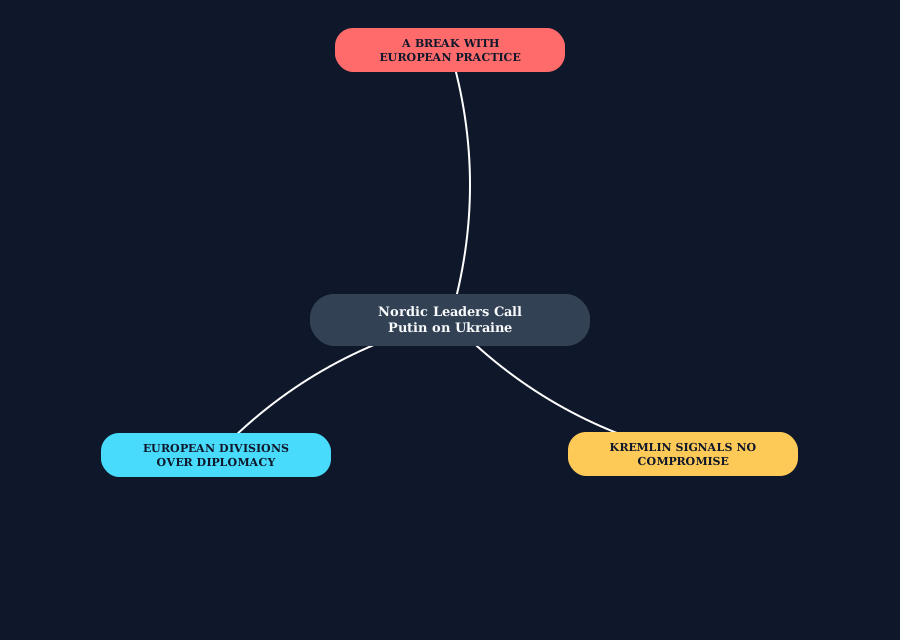
Nordic Leaders Call Putin on Ukraine
Finland and Norway break with European practice by phoning Putin to urge an end to the Ukraine war, as US policy shifts and Denmark objects.
Key points
- The leaders of Finland and Norway called Russian President Vladimir Putin on Tuesday to urge him to end the war in Ukraine.
- The move breaks with a longstanding practice among Western European leaders of shunning direct contact with the Kremlin.
- Finnish President Alexander Stubb and Norwegian Prime Minister Jonas Gahr Stoere spoke by phone to Putin and afterwards to Ukrainian President Volodymyr Zelenskiy, according to a Zelenskiy aide.
- The call was an attempt to influence the diplomatic process at a time when US President Donald Trump has shifted his position in favour of Russia and US ties with Ukraine have hit their lowest point in 18 months.
The leaders of Finland and Norway called Russian President Vladimir Putin on Tuesday to urge him to end the war in Ukraine.
The move breaks with a longstanding practice among Western European leaders of shunning direct contact with the Kremlin.
Finnish President Alexander Stubb and Norwegian Prime Minister Jonas Gahr Stoere spoke by phone to Putin and afterwards to Ukrainian President Volodymyr Zelenskiy, according to a Zelenskiy aide.
The call was an attempt to influence the diplomatic process at a time when US President Donald Trump has shifted his position in favour of Russia and US ties with Ukraine have hit their lowest point in 18 months.
The Nordic leaders stressed their strong support for Ukraine, which they said would continue.
Stubb described the discussion as frank and substantive, noting that Finland and Norway are neighbours of Russia and that the war's outcome will directly affect their and broader European security.
Stoere stressed the importance of de-escalation, saying the war carries enormous human and material costs that will affect generations.
A Break With European Practice
The Kremlin's readout did not suggest that Putin signalled any compromise from previously stated positions.
It emphasised that a just and long-term peace is possible only if the legitimate interests of the Russian Federation are fully and unconditionally taken into account, and it drew attention to the confrontational policies of EU and NATO countries, which it said prolong hostilities.
A source close to the Kremlin told Reuters that Putin told Stubb and Stoere that Russia would not compromise over its aim to capture the whole of Ukraine's Donbas region.
The Europeans responded by saying that a just peace is needed.
The source added that French President Emmanuel Macron was the last EU leader to speak with Putin by phone, in July, in a call that was not made public and yielded no results.
Kremlin Signals No Compromise
Western European leaders have mostly shunned contact with Putin while piling sanctions on Moscow since Russia launched its full-scale war in Ukraine in February 2022.
That stance has left them sidelined as efforts to end the war have been led by Trump, who is seen in many EU capitals as unpredictable, erratic, and prone to side with Putin at Ukraine's expense.
That perception has been reinforced by deals this month in which Putin agreed to supply Russian diesel to the US and Trump eased sanctions on Russia while saying it was time for Ukrainians to replace Zelenskiy as their leader.
Ukraine has also complained of disruption to US intelligence sharing and to satellite internet services on which its military relies.
Danish Prime Minister Mette Frederiksen criticised the Finnish-Norwegian decision to talk to Putin, saying she saw no signs that Russia wants peace and that Europe should stick together rather than go solo.
Stubb and Stoere replied that they participated as leaders of their respective countries and did not speak on behalf of Europe as a whole.
European Divisions Over Diplomacy
Russia has frequently accused European governments of stoking the war by arming Ukraine and refusing direct talks, contrasting Western European leaders with Trump, who has engaged with Putin and tried, so far without success, to broker a peace agreement.
The Nordic call thus reflects a wider debate over whether isolation or engagement offers the better path to ending the conflict.
For neighbouring states, the stakes are concrete: the outcome of the war will shape their security environment for years.
The call underscores how European unity on Russia policy is fraying under the pressure of an unpredictable US administration and a war that shows no sign of ending.