US Q3 GDP Beats Forecast as AI Spending Offsets Oil Shock
US economy grew 3.4% in Q3 2026, beating forecasts, as AI investment and consumer spending offset oil price shocks from the Middle East conflict.
Key points
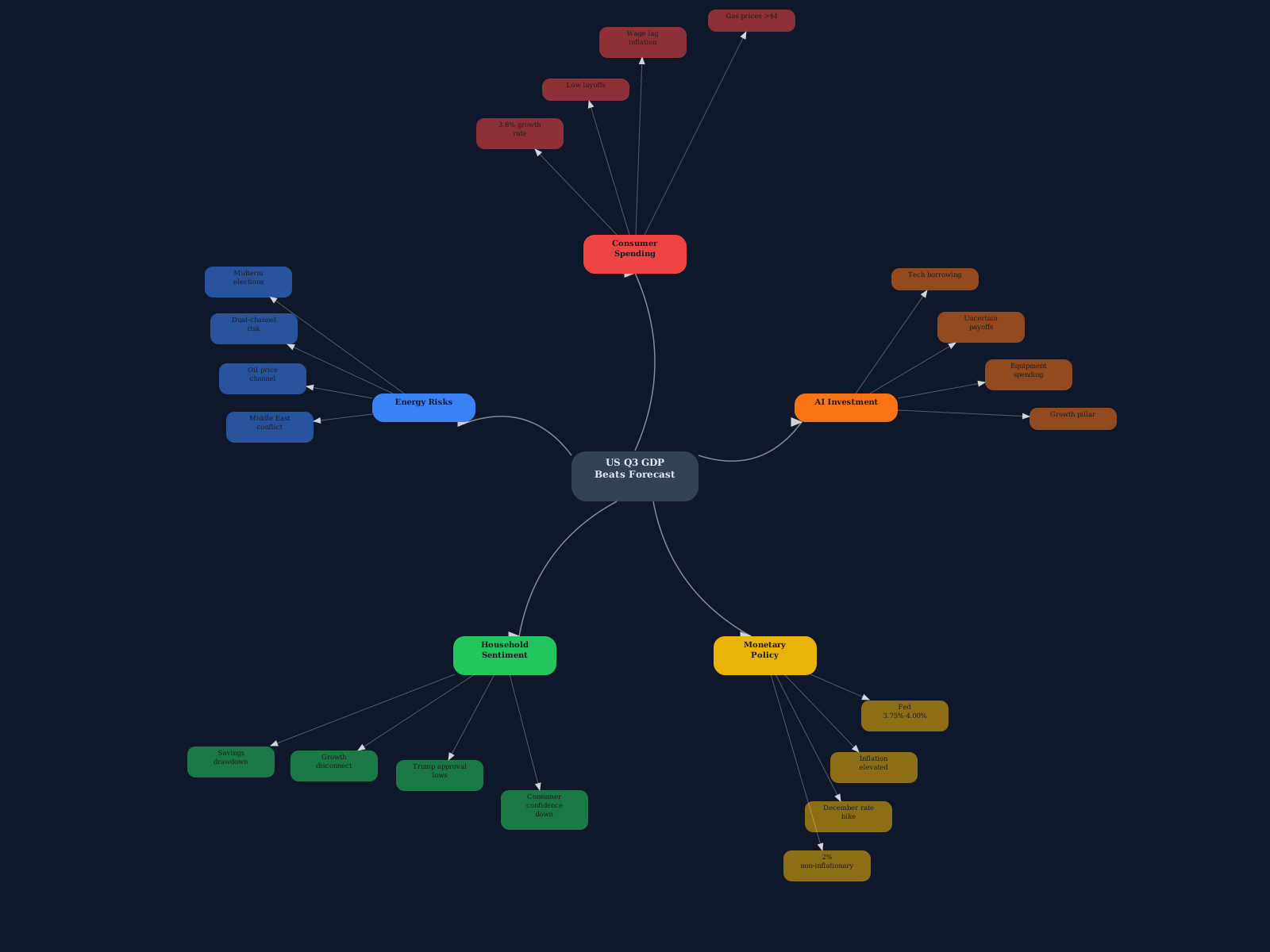
- US Q3 2026 GDP grew 3.4% annualized, beating the 3.2% consensus forecast.
- Consumer spending rose 3.8%, supported by resilient labor markets and household savings drawdowns.
- AI-driven business investment emerged as a distinct growth pillar, funded by heavy corporate borrowing.
- The Federal Reserve held rates at 3.75%-4.00% and economists expected a December increase.
- Middle East conflict operates as a dual-channel risk: higher oil prices and investment uncertainty.
The US economy expanded at a 3.4% annualized pace in the third quarter of 2026, outperforming the 3.2% consensus forecast, as resilient consumer spending and AI-driven business investment more than offset the drag from higher oil prices linked to the Middle East conflict.
The Commerce Department's Bureau of Economic Analysis released the advance estimate on Thursday, less than a week before midterm elections that will determine control of Congress.
Consumer Spending and Labor Market Resilience
Consumer spending, which accounts for more than two-thirds of economic output, grew at a 3.8% rate in the July-September quarter, matching the prior quarter's pace.
Historically low layoffs and moderate hiring underpinned household outlays, though wage gains at times lagged inflation and households drew down savings to sustain consumption.
With average gasoline prices still above four dollars per gallon as the US-Israeli war with Iran drags on, economists anticipated a slowdown in consumer spending in the months ahead.
AI Investment and Growth Quality
AI-related investment emerged as a distinct growth pillar.
Tech firms borrowed heavily over the past year to fund AI projects, and some economists cautioned that the resulting GDP strength may not fully reflect underlying economic health.
Investors increasingly focused on the rising costs of long-term AI projects with uncertain payoffs, raising questions about the durability of equipment spending even as the current quarter showed robust investment.
Monetary Policy and Inflation Outlook
The Federal Reserve left its benchmark rate unchanged at 3.75%-4.00% on Wednesday, acknowledging that inflation "remains elevated."
The economy is expanding well above the roughly 2% non-inflationary growth rate that some Fed officials regard as sustainable.
Economists expected a December rate increase.
Fed Chairman Kevin Warsh noted that "economic activity is expanding at a strong pace," while acknowledging that uncertainty persists owing in part to external conflict dynamics — a framing that ties domestic monetary policy to events in the Middle East.
Household Sentiment and the Growth Disconnect
The report highlighted a tension between aggregate growth and household sentiment.
Consumer confidence deteriorated sharply even as output accelerated, and President Trump's approval ratings reached record lows.
The strength in growth stood in stark contrast to households' downbeat assessment of the economy, creating a disconnect that analysts linked to persistent inflation, elevated energy costs, and uneven wage gains.
Energy Risks and External Dependencies
For the broader outlook, the Middle East conflict operates as a dual-channel risk: it raises oil prices that squeeze consumer budgets and business margins, while also creating uncertainty that could dampen investment planning.
The direct impact on US GDP remains limited because domestic energy production provides partial insulation, but the price transmission to gasoline and transport costs is immediate and salient to voters.
The report's timing — days before midterm elections — amplified its significance without changing its economic substance.
The underlying data suggest an economy running above potential but with accumulating risks: a consumer sector dependent on savings drawdowns, an investment boom concentrated in AI with uncertain returns, and external energy shocks that could intensify if the Middle East conflict escalates.